Curve Conveyors
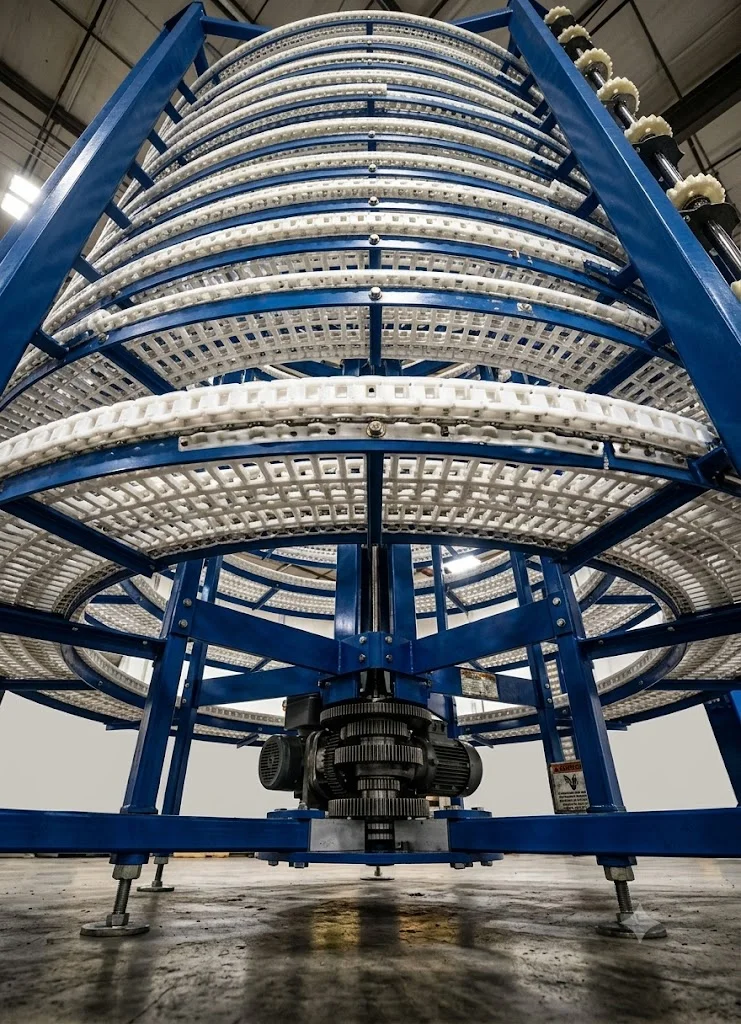
Curve Conveyors
Curved conveyor modules that change line direction by 30°–180° for flexible layouts.
What Are Curve Conveyors?
Curve conveyors (turn or bend conveyors) are strategic routing modules, usually designed at angles of 30, 45, 90 or 180 degrees, used to change the direction of material flow within a facility and connect straight lines running in different directions. Where straight lines are insufficient or obstacles must be routed around, they provide uninterrupted transfer without disturbing the products' position. They can be manufactured in belt, roller or modular-belt form depending on the structure of the product to be carried.
What Are the Key Advantages?
The greatest advantage of these systems is that they allow the facility's existing physical space (footprint) to be used with maximum efficiency. By overcoming obstacles along walls, between columns or in tight areas, they give production and logistics lines unique flexibility. Belt curve conveyors preserve the orientation (direction and position) the products had on entering the line, as well as the gap between products, during the turn. This ensures products leave the line aligned ahead of sensitive operations such as barcode reading or sorting, completely eliminating the risk of jamming and falling at corners.
In Which Sectors and Applications Is It Used?
They are a mandatory part of any facility where space optimization is critical and long, complex intralogistics networks are built. They are used intensively in parcel and postal sorting centers, e-commerce order-picking lines and airport baggage handling (carousel) systems. They also play a key role in mass-production factories such as food, beverage, pharmaceutical and automotive, wherever production lines need to bend to suit the facility's architecture or transfer between different floors.
What Should You Consider When Investing?
Design engineering in curve conveyors is highly precise. By calculating the maximum length and width of the product to be carried, the system's inner and outer turn radius must be set correctly so the product does not jam. If roller curve systems are preferred, tapered rollers must be used to prevent products from being thrown outward and changing direction due to centrifugal force. If irregular, flat-bottomed or bagged packages of various sizes are to be carried, belt curve conveyors that provide smooth transfer should be preferred. In addition, the turn module's motor speed must run in synchronization with the straight lines feeding in and out without a millisecond of delay; otherwise bottlenecks are inevitable.
Why ACS Intralogistics Solutions?
As ACS Intralogistics Solutions, we engineer high-precision curve conveyor architectures that turn your facility's architectural challenges into a smooth intralogistics advantage rather than an obstacle.
We design smooth transfer points (knife-edge transitions) that prevent your products from losing direction, colliding with one another or leaving the line as they round corners at speed. We install our turn modules not merely as a mechanical bridge but as part of an integrated automation network fully synchronized with the system's sensors, aligner units, barcode reading tunnels and high-speed sorter lines. No matter how tight or complex your space, we ensure your products turn the corners safely and without losing speed.